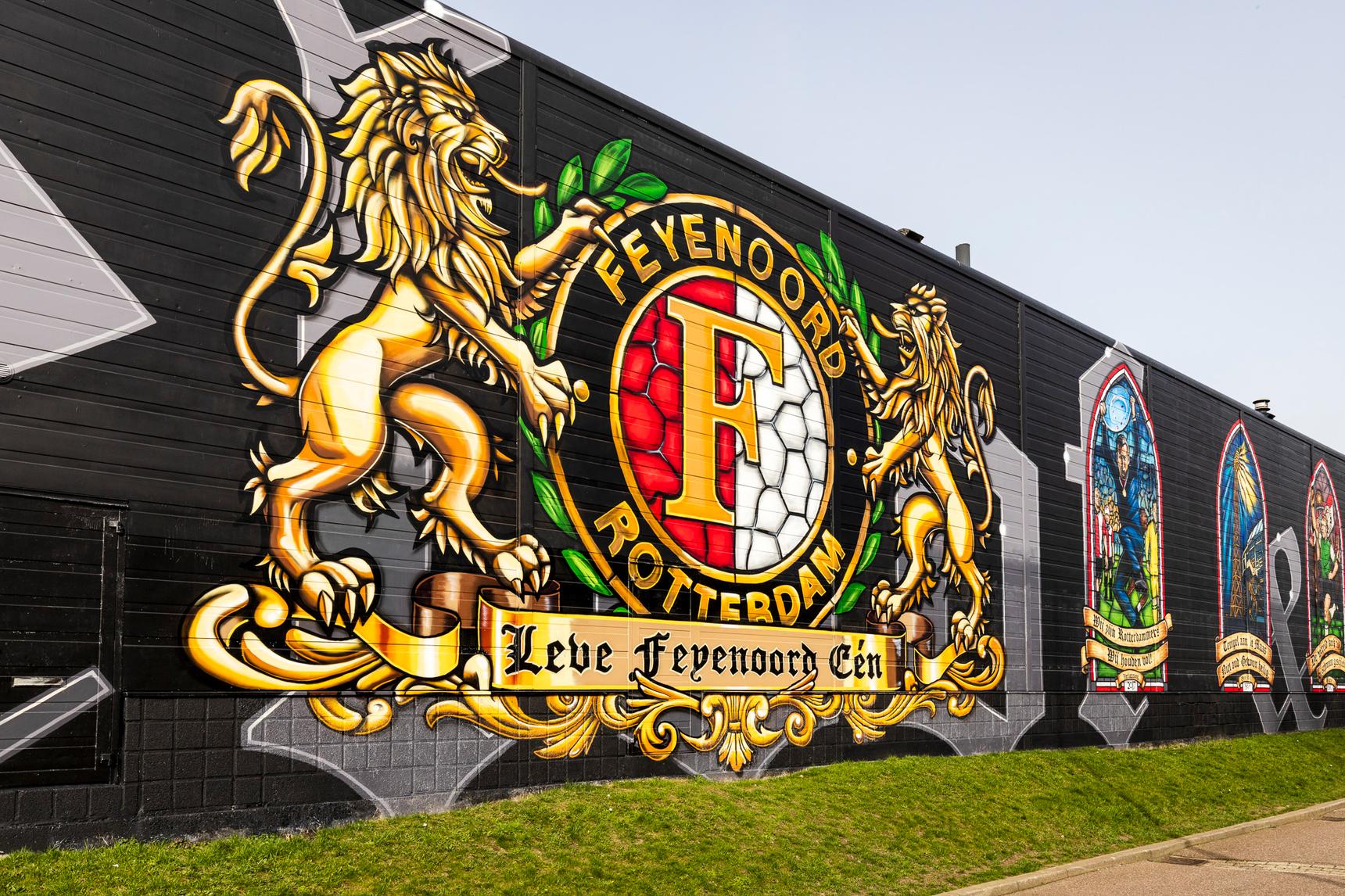
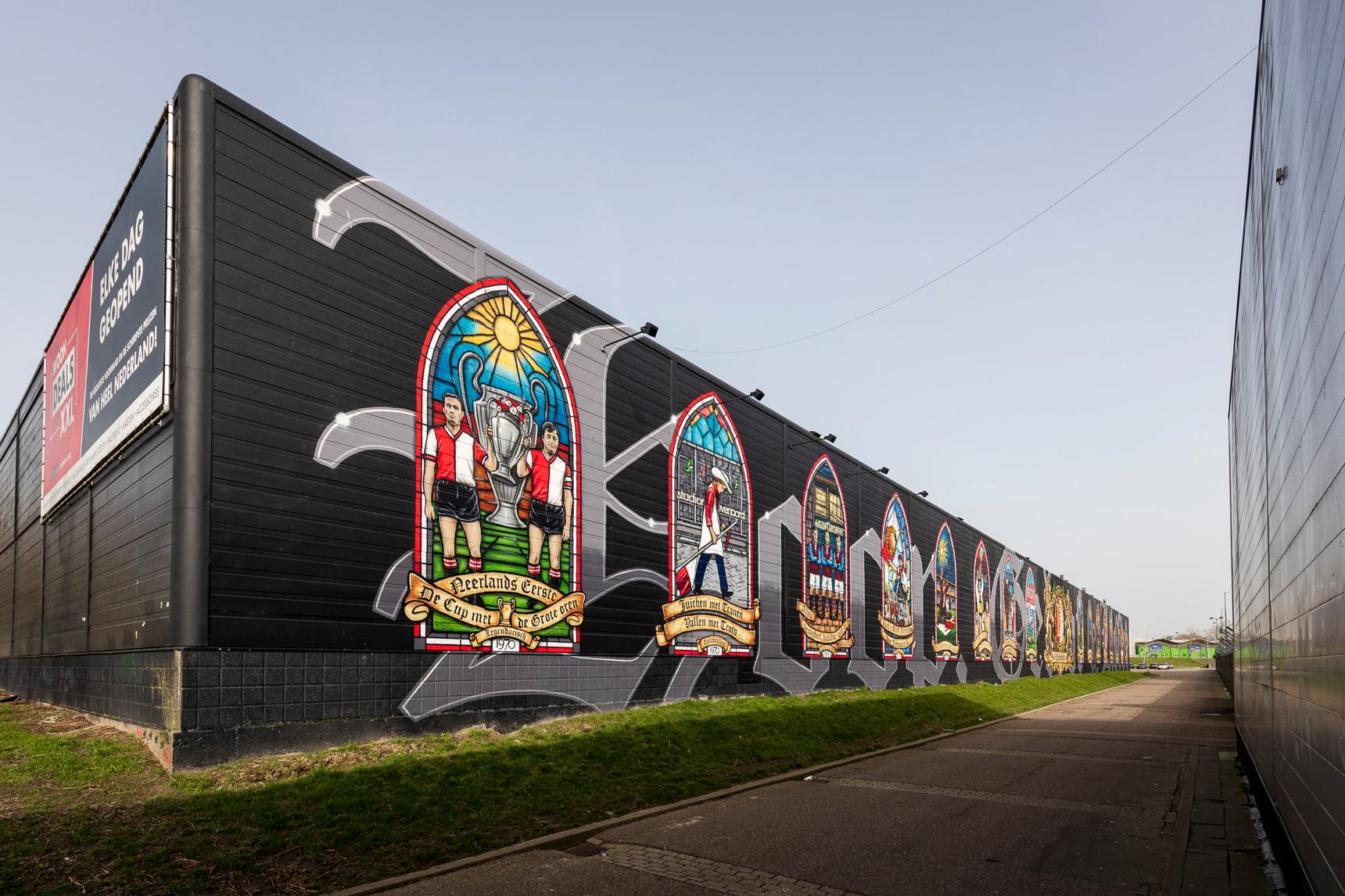
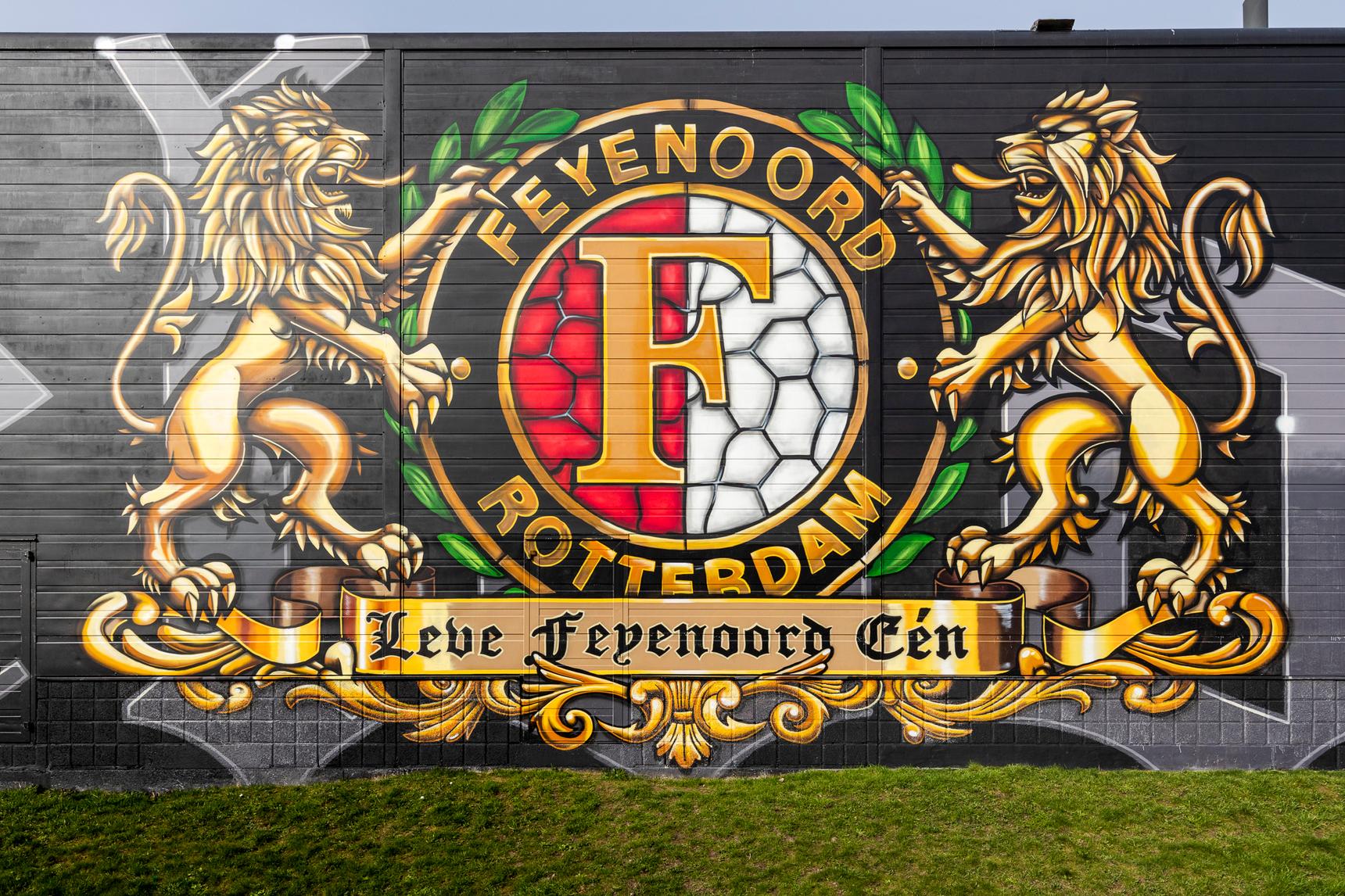
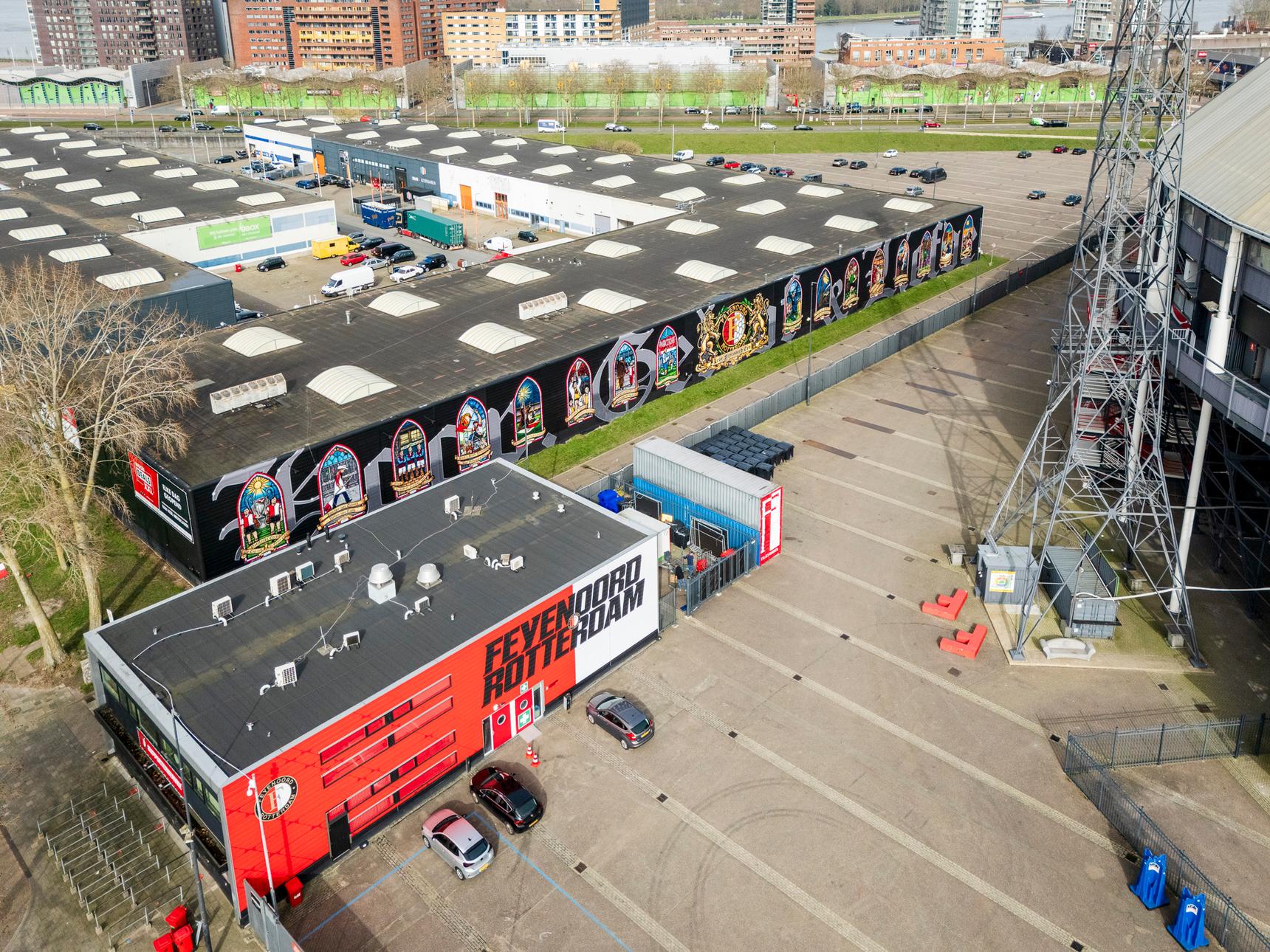
This - very - large mural directly next to the stadium tells the history of Feyenoord in 16 stain glass windows. Every window has a back story; a pivotal moment in the clubs history, fan moments, iconic figures of the club.
The stories from left to right:
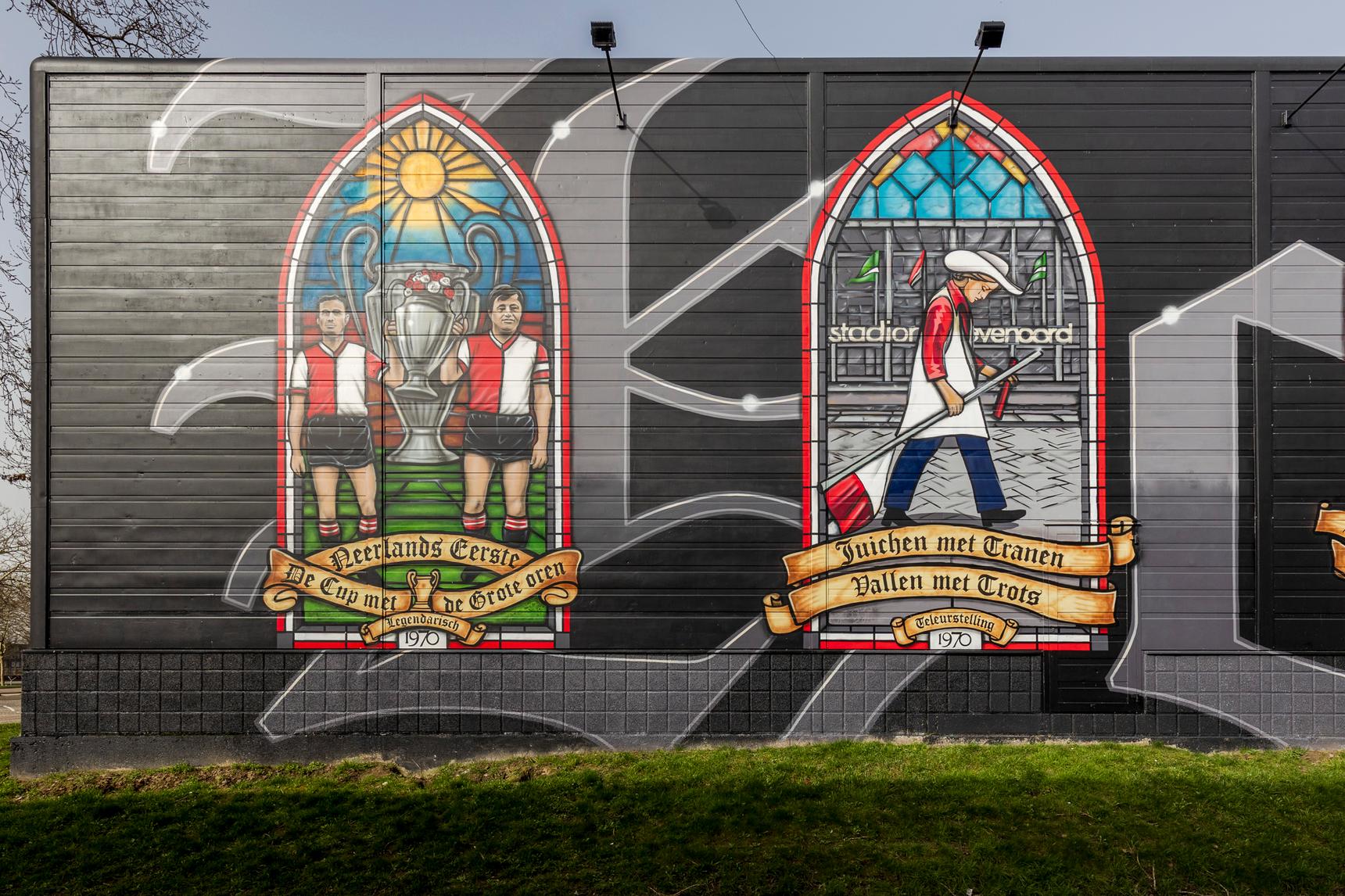
Legendarisch (Legendary) 1970:
Rinus Israël and Ove Kindvall scored the two goals that won Feyenoord the European Cup final against Celtic, making them the first Dutch club in the history of the league to do so. Both club icons sadly passed away while the mural was being painted.
Teleurstelling (Disapointment) 1970:
After winning the European Cup final and on week after winning the World cup, Feyenoord was eliminated from the next European season in the first round by losing from a small Romanian club. Euphoria and Disapointment always lie close together for a fan of Feyenoord...
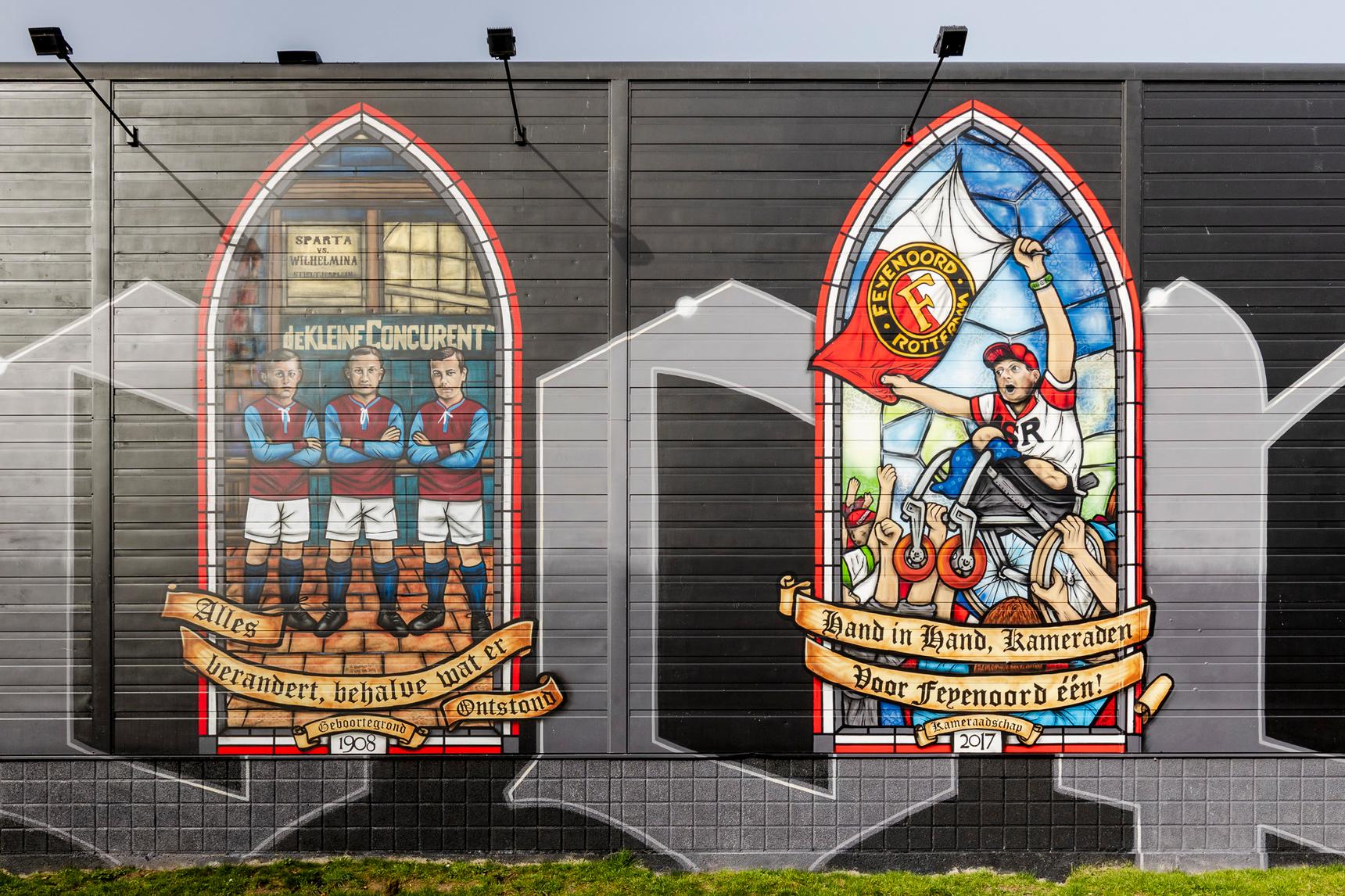
Geboortegrond (Birthplace) 1908:
The club was founded in 1908 by a group of friends. We see them depicted in front of the candy shop "De Kleine Concurent", which was the place they used to get dressed for the matches.
Kameraadschap (Commeradery) 2017:
In 2017, after winning the national championship, supporter Adrie Willemstein was lifted up in the air in his weelchair by fellow supporters in the celebrations. This is telling for the commeradery the fans feel amongst each other.
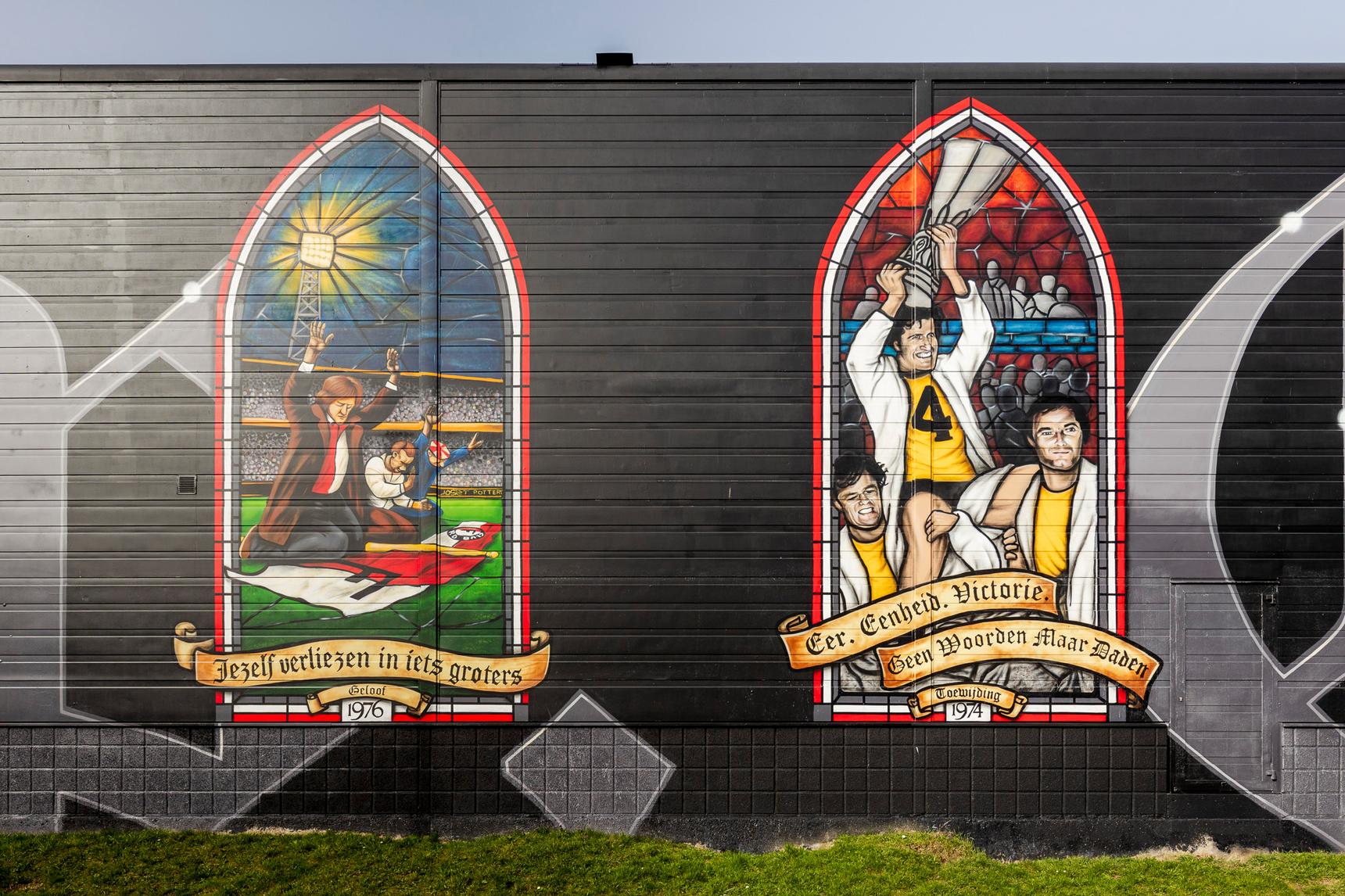
Geloof (Faith) 1976:
In the 1970's it was not uncommon for supporters to get up on the pitch with their flags and pray for a good result. Many fans see being a supporter of Feyenoord as their religion.
Toewijding (Dedication) 1974:
In 1974 Feyenoord beat Tottenham Hotspur to win the EUFA Cup final over two matches. Wim Jansen, Rinus Israël and Mladen Ramljak celebrate with the cup.
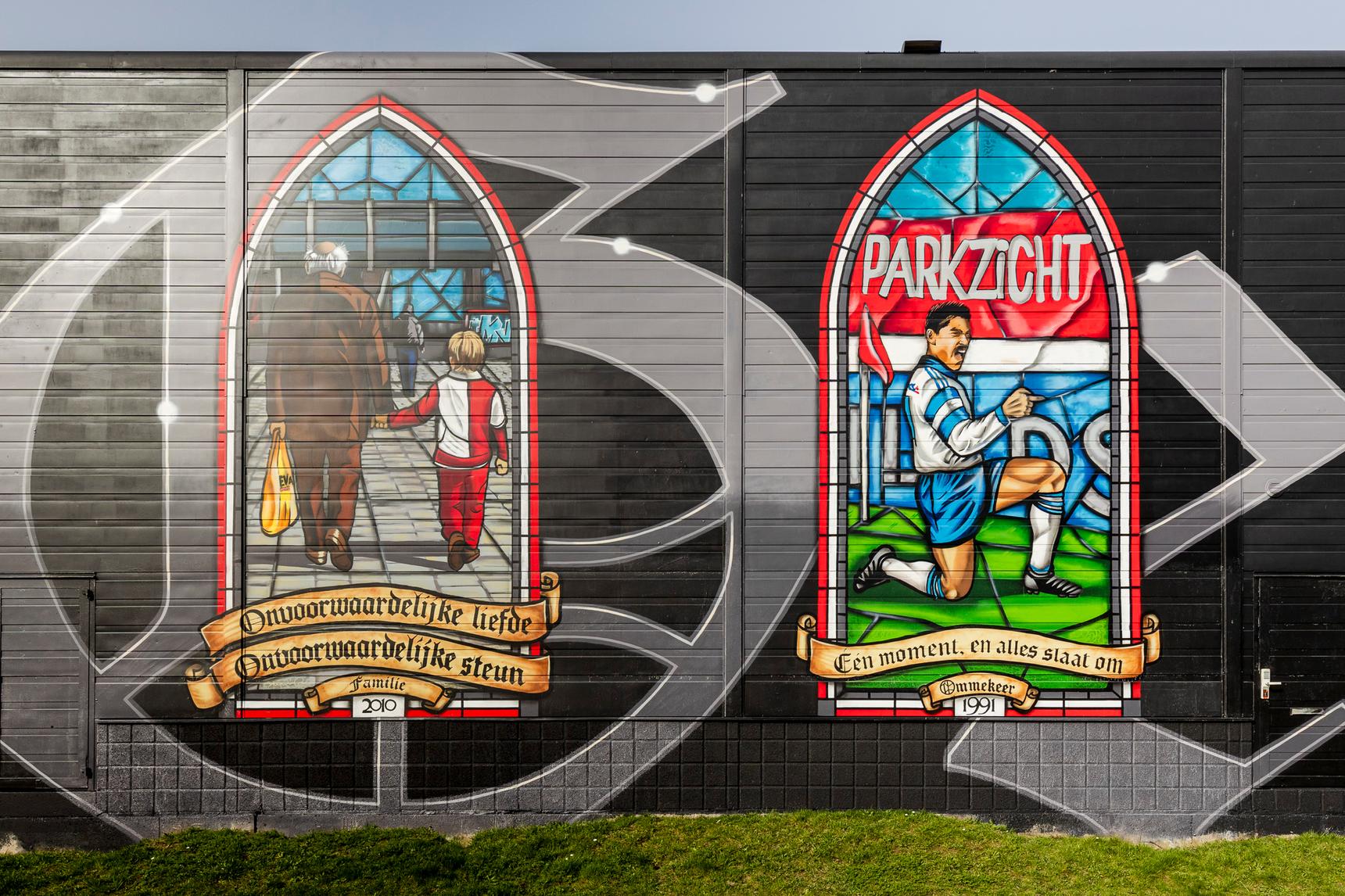
Familie (Family) 2010:
Family is a big part of Feyenoord; multiple generations from the same family regularly visit the games. This photo was taken of a grandfather visiting the stadium with his grandson.
Ommekeer (Turnaround) 1991:
After a long dark period for Feyenoord in the 1980's, the League Cup semi-final against PSV was a turning point. Henk Fräser scored the winning goal, earning a spot in the finals the where also won. After that Feyenoord got into the European leagues again and started earning more successes.
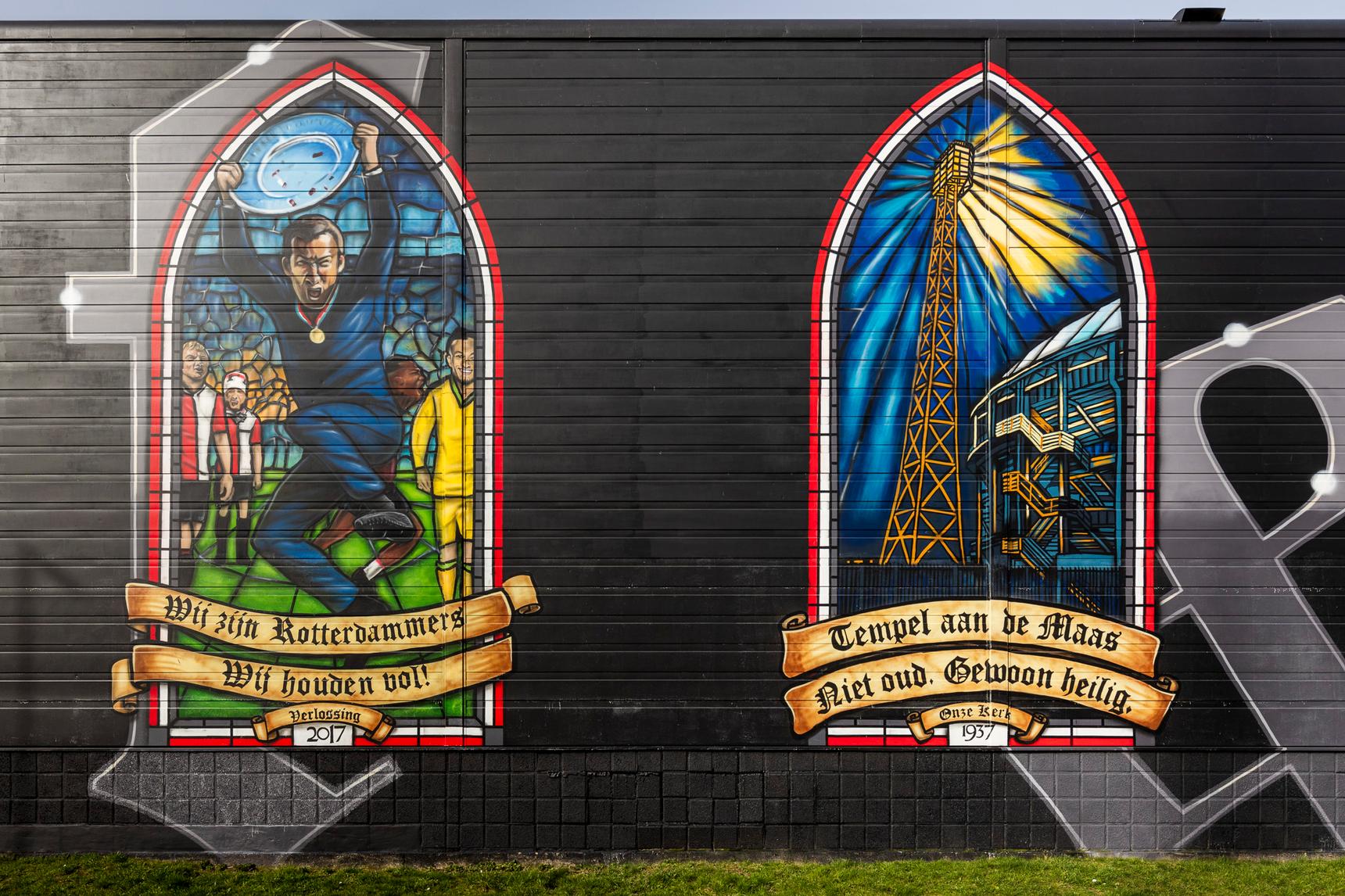
Verlossing (Salvation) 2017:
In 2017, after 18 years, Feyenoord finaly won another national championship again under the management of Giovanni van Bronckhorst. Van Bronckhorst was raised in Rotterdam and after playing in the youth of Feyenoord was a very succesful player of the main team. He went on to play for legendary clubs like Liverpool and Barcelona before coming back to Feyenoord late in his career. He later started coaching and grew in to being the head coach of Feyenoord. After suffering a rough start, things started to kick off, resulting in the Championship win in his second year as head coach.
Onze kerk (Our church) 1937:
"De Kuip" is known as the most atmospheric stadium in the country, and for many supporters even the world. Built in 1937 it is still the best. Every sunday this church is filled with the religious followers of the club.
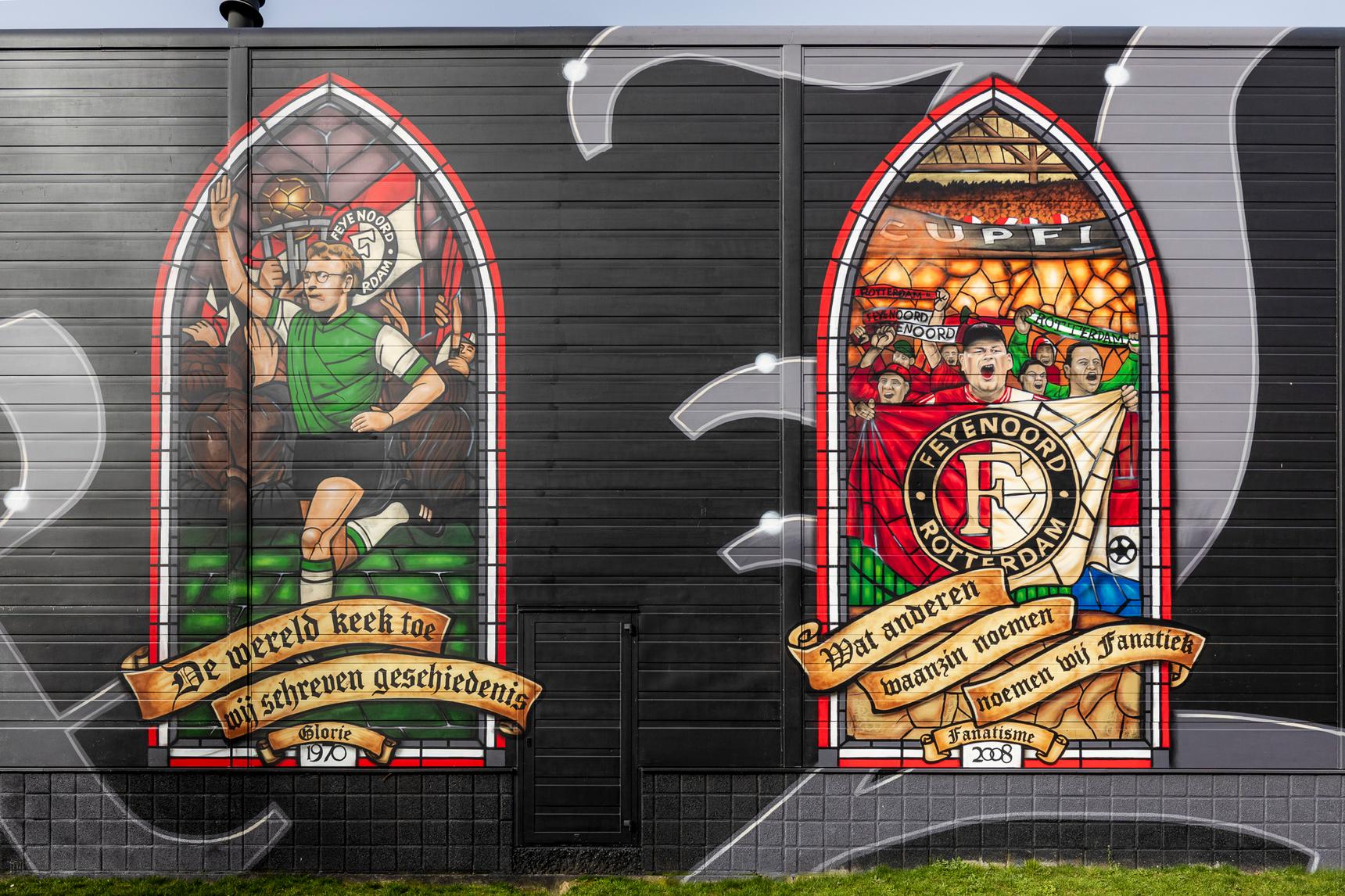
Glorie (Glory) 1970:
The year 1970 was the most succesful one in the history of the club. After winning the European Cup (see the first windows), Feyenoord played and won the World Cup final against Estudiantes from Argentina. Directly after Joop van Daele scored what later turned out to be the winning goal, player from the opposing team stole his glasses and broke them, claiming that in Argentina it was illegal to play with glasses on. The glasses are still on display in the Feyenoord Museum in the stadium.
Fanatisme (Fanatism) 2008:
The fans of Feyenoord are known for being the most fanatical in the country. Often feared by opponents, the crowd is seen as one of the strong points of the team. Always singing, chanting, shouting, lighting pyro, working up the players and nerving the opposing teams. The image is from the 2008 League Cup final against Roda JC which was won by 2-0 with the help of the supporters.
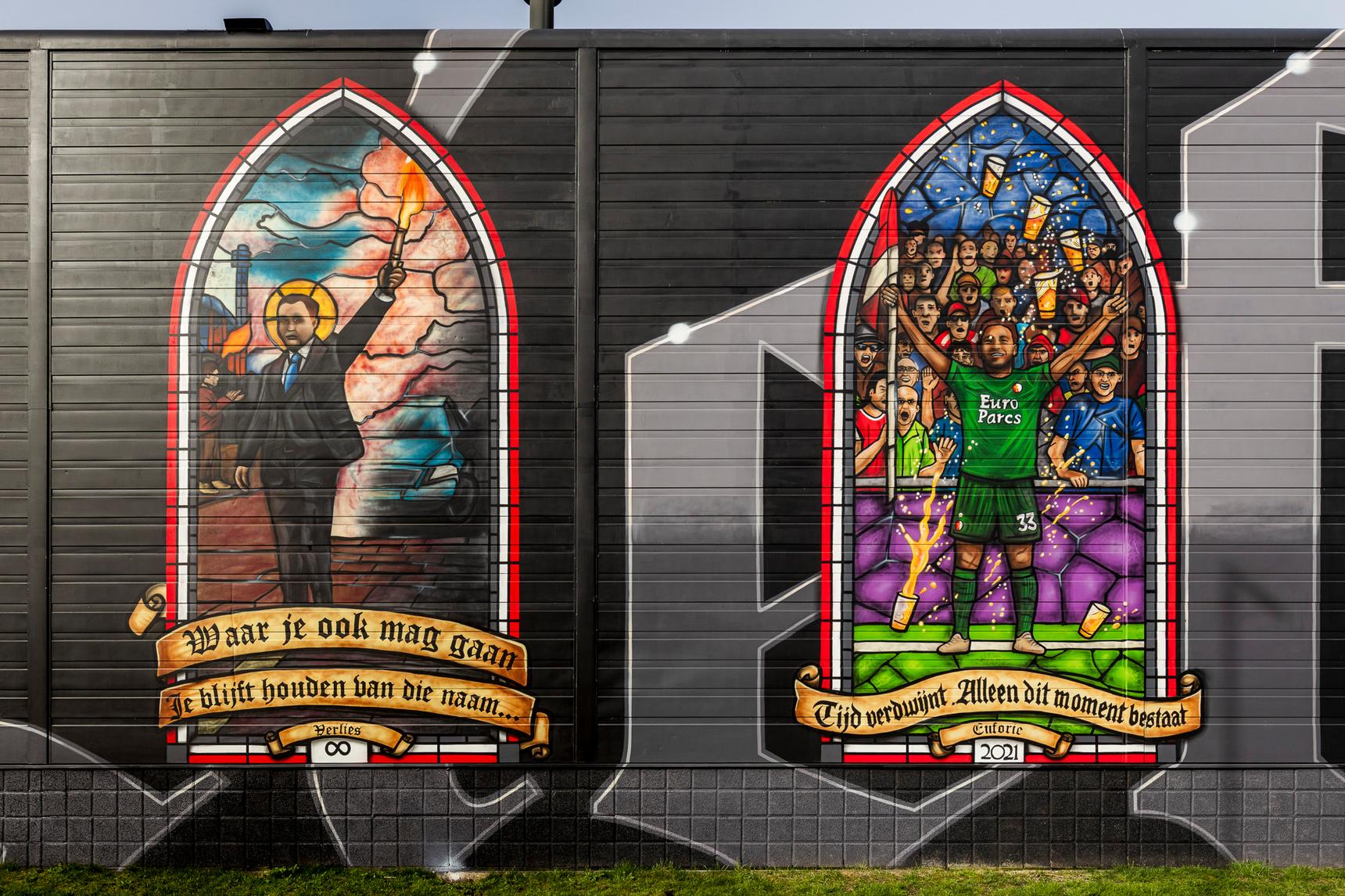
Verlies (Loss) ∞:
You are a Feyenoord support for life. And beyond. Whenever a person with strong ties to the club passes away, an impressive goodbye is organized by the fans. Often passing the stadium on the way to the funeral home, they receive a sending of like only the Feyenoord legion can give.
Euforie (Euphoria) 2021:
When Cyriel Dessers came to play for Feyenoord, he posted a somewhat cocky message about cheering with the corner flag to celebrate his first goal on social media. But he came through and scored the 0-4 goal in the match against PSV, after which he made good on his promise and do his dance with the flag in front of the furious PSV supporters. This action earned him immediate stardom amongst the Feyenoord fans. He went on to score many more goals in the only season he played for the club, becoming the top scorer in the UEFA Conference league that year.
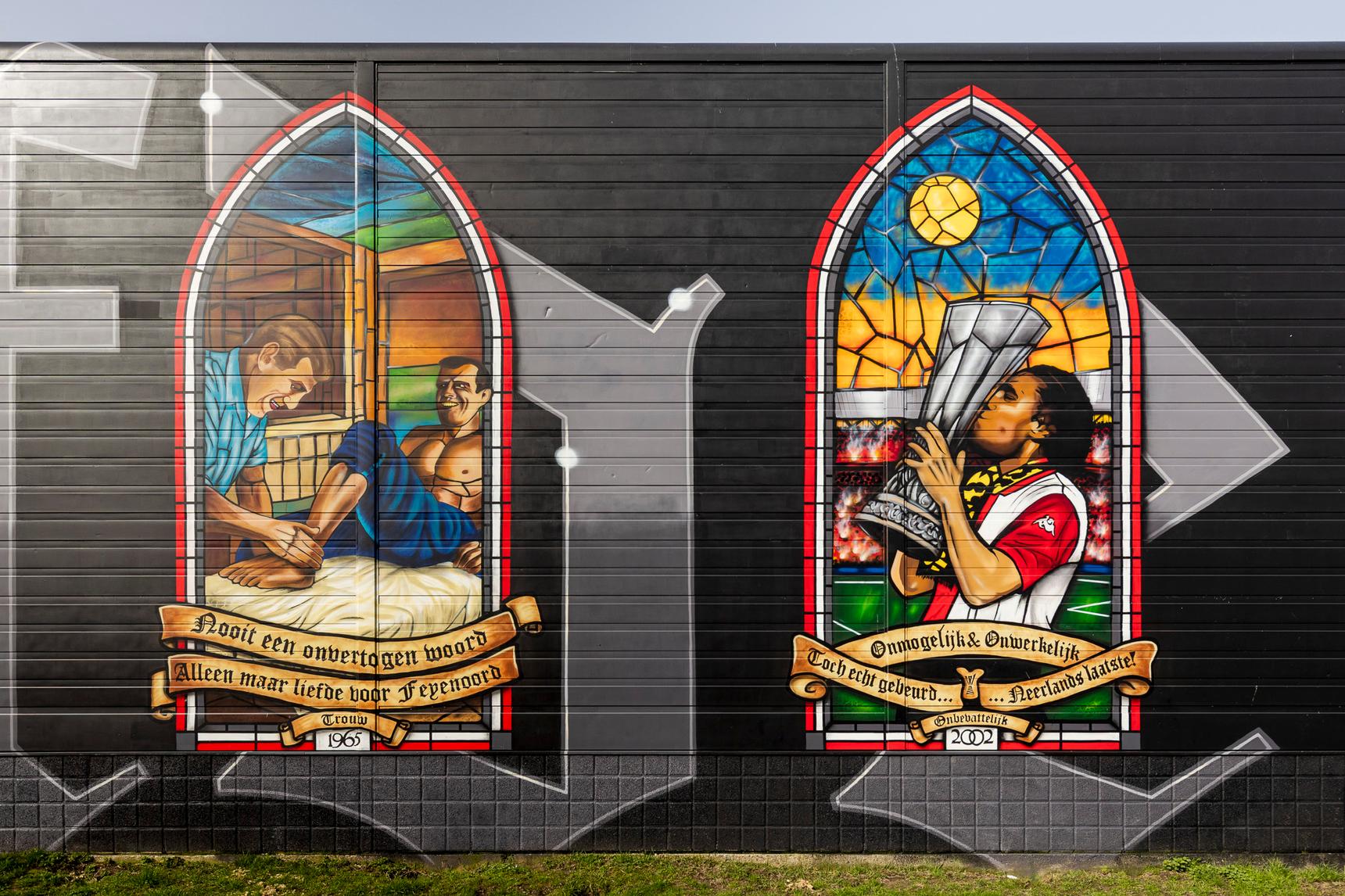
Trouw (Loyalty) 1965:
Gerard Meijer was the physical therapist for Feyenoord for 50 years up until 2009. This kind of loyalty is greatly appreciated with Feyenoord and for that he got one of the stands named after him. In the photo he is seen massaging another icon of the club, Coen Moulijn, who as a player passed on opportunities to move to far greater clubs abroad because he saw himself as a Feyenoord player.
Onbevattelijk (Incomprehensible) 2002:
This year the UEFA Cup final was played in "De Kuip" and, low and behold, Feyenoord made it into the finals to play against Borrusia Dortmund in their home stadium. Two goals by Pierre van Hooijdonk got Feyenoord on track for a 3-2 win.
The mural was created by the same team that also paints the enormous banners that decorate the stands for big matches.
=====
Deze - zeer - grote muurschildering direct naast het stadion vertelt de geschiedenis van Feyenoord aan de hand van 16 glas-in-loodramen. Elk raam heeft een eigen verhaal; een cruciaal moment in de clubgeschiedenis, supportersmomenten of iconische clubfiguren.
De verhalen van links naar rechts:
Legendarisch 1970: Rinus Israël en Ove Kindvall scoorden de twee doelpunten waarmee Feyenoord de Europacup I-finale won van Celtic. Hiermee waren zij de eerste Nederlandse club in de geschiedenis die deze beker won. Beide clubiconen overleden helaas terwijl de muurschildering werd geschilderd.
Teleurstelling 1970: Na het winnen van de Europacup I en slechts een week na het winnen van de Wereldbeker, werd Feyenoord in de eerste ronde van het volgende Europese seizoen uitgeschakeld door een kleine Roemeense club. Euforie en teleurstelling liggen voor een Feyenoord-fan altijd dicht bij elkaar...
Geboortegrond 1908: De club werd in 1908 opgericht door een groep vrienden. We zien hen hier afgebeeld voor snoepwinkel "De Kleine Concurrent", de plek waar zij zich destijds omkleedden voor de wedstrijden.
Kameraadschap 2017: In 2017, na het behalen van het landskampioenschap, werd supporter Adrie Willemstein tijdens de festiviteiten in zijn rolstoel de lucht in getild door mede-supporters. Dit is typerend voor de kameraadschap die de fans onderling voelen.
Geloof 1976: In de jaren '70 was het niet ongewoon dat supporters met hun vlaggen het veld op kwamen om te bidden voor een goed resultaat. Veel fans zien het supporter zijn van Feyenoord als hun religie.
Toewijding 1974: In 1974 versloeg Feyenoord Tottenham Hotspur in een finale over twee wedstrijden om de UEFA Cup te winnen. Wim Jansen, Rinus Israël en Mladen Ramljak vieren hier feest met de beker.
Familie 2010: Familie is een essentieel onderdeel van Feyenoord; meerdere generaties uit hetzelfde gezin bezoeken regelmatig de wedstrijden. Deze foto werd genomen van een opa die met zijn kleinzoon het stadion bezoekt.
Ommekeer 1991: Na een lange, donkere periode voor Feyenoord in de jaren '80, was de halve finale van de KNVB Beker tegen PSV een keerpunt. Henk Fräser scoorde het winnende doelpunt, wat een plek in de finale opleverde die ook werd gewonnen. Daarna keerde Feyenoord terug in de Europese competities en volgden er weer meer successen.
Verlossing 2017: In 2017 werd Feyenoord na 18 jaar eindelijk weer landskampioen onder leiding van Giovanni van Bronckhorst. Van Bronckhorst groeide op in Rotterdam en was, na de jeugdopleiding van Feyenoord te hebben doorlopen, een zeer succesvolle speler in het eerste elftal. Hij speelde voor legendarische clubs als Liverpool en Barcelona voordat hij aan het einde van zijn carrière terugkeerde bij Feyenoord. Later werd hij trainer en groeide hij door tot hoofdcoach. Na een moeizame start viel alles op zijn plek, met het kampioenschap in zijn tweede jaar als hoofdcoach als resultaat.
Onze kerk 1937: "De Kuip" staat bekend als het meest sfeervolle stadion van het land, en volgens veel supporters zelfs van de wereld. Gebouwd in 1937 is het nog steeds het beste stadion. Elke zondag wordt deze kerk gevuld met de gelovige volgers van de club.
Glorie 1970: Het jaar 1970 was het meest succesvolle jaar in de geschiedenis van de club. Na het winnen van de Europacup (zie het eerste raam), won Feyenoord ook de Wereldbeker na een finale tegen het Argentijnse Estudiantes. Direct nadat Joop van Daele het winnende doelpunt scoorde, stal een speler van de tegenstander zijn bril en trapte deze kapot, met de bewering dat het in Argentinië illegaal was om met een bril op te spelen. De bril is nog steeds te zien in het Feyenoord Museum in het stadion.
Fanatisme 2008: De fans van Feyenoord staan bekend als de meest fanatieke van het land. Vaak gevreesd door tegenstanders, wordt het publiek gezien als een van de sterkste punten van het team. Altijd zingen, schreeuwen, vuurwerk afsteken, de eigen spelers opzwepen en de tegenstander uit hun concentratie halen. De afbeelding is van de bekerfinale in 2008 tegen Roda JC, die met 2-0 werd gewonnen met de hulp van de supporters.
Verlies ∞: Je bent Feyenoorder voor het leven. En daarna. Wanneer een persoon met sterke banden met de club overlijdt, organiseren de fans een indrukwekkend afscheid. Vaak passeert de stoet het stadion op weg naar het uitvaartcentrum, waarbij ze een eerbetoon krijgen zoals alleen het Feyenoord-legioen dat kan geven.
Euforie 2021: Toen Cyriel Dessers bij Feyenoord kwam, plaatste hij een tikkeltje brutale post op sociale media over het juichen met de cornervlag bij zijn eerste doelpunt. Hij maakte zijn woorden waar en scoorde de 0-4 in de wedstrijd tegen PSV, waarna hij zijn belofte nakwam en zijn dansje deed met de vlag voor de woedende PSV-supporters. Deze actie leverde hem direct een heldenstatus op bij de Feyenoord-fans. Hij scoorde nog vele doelpunten in het enige seizoen dat hij voor de club speelde en werd dat jaar topscorer van de UEFA Conference League.
Trouw 1965: Gerard Meijer was 50 jaar lang de fysiotherapeut van Feyenoord, tot aan 2009. Dit soort trouw wordt bij Feyenoord enorm gewaardeerd; er is zelfs een tribune naar hem vernoemd. Op de foto is hij te zien terwijl hij een ander icoon masseert: Coen Moulijn, de speler die kansen om naar veel grotere buitenlandse clubs te gaan afsloeg omdat hij zichzelf door en door als Feyenoorder zag.
Onbevattelijk 2002: In dit jaar werd de UEFA Cup-finale gespeeld in "De Kuip" en, wonder boven wonder, Feyenoord haalde de finale om in het eigen stadion aan te treden tegen Borussia Dortmund. Twee doelpunten van Pierre van Hooijdonk hielpen Feyenoord op weg naar een 3-2 overwinning.
De muurschildering is gemaakt door hetzelfde team dat ook de enorme spandoeken schildert die de tribunes sieren bij grote wedstrijden.
Marker details
| Last seen | 2026-05-31T18:27:33.876Z |
|---|---|
| Access | Public |
| Artwork subject | Football, Soccer, Feyenoord, Sport |
| Artwork type | Mural |
| Camera used | Canon EOS R |
| Date created | 2025-09-12T10:00:00.000Z |
| Height | 6 |
| Organization | De Feijenoorder, FRFC1908 |
| Width | 110 |
| Marker type | artwork |
| City | Rotterdam |
| Country | Netherlands |